









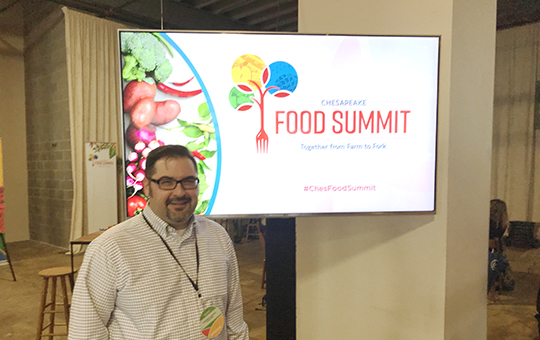
Steve Levitsky, VP of Sustainability, at the Chesapeake Food Summit
Chesapeake Food Summit Brought Together Diverse Stakeholders
Agriculture and Environmentalists On the Same Side of the Table
October 8, 2018
By Steve Levitsky, Vice President, Sustainability, Perdue Farms
The inaugural Chesapeake Food Summit was another demonstration that the most productive way to address the issues surrounding our food system – local, regional and national – is to bring together a wide range of stakeholders. Local producers and markets, food hubs, agencies and food companies spent two days exploring our common ground, sharing ideas and perspectives and listening to each other.
Attendees gained a deeper understanding that we are all part of creating a food system that is economically and environmentally sustainable, that is fair and humane, and that increases access to good, nutritious food for everyone. Perdue Farms supports finding common ground on issues surrounding food production and distribution, which is why we helped sponsor the Chesapeake Food Summit.
I participated in a panel discussion, “Health of the Chesapeake: Threats & Advancements in our Region.” I was joined by Chanté Coleman of the Choose Clean Water Coalition, representing more than 230 environmental organizations in the Bay region, and Peter Goodwin of the University of Maryland Center for Environmental Science. We had, on the same side of the table, representation from environmental advocates, academia and production-scale agriculture and food processing.
It certainly helped that we had good news to share. Chesapeake Bay restoration efforts have turned a corner: dead zones are getting smaller, underwater grasses have recovered to record highs for the second consecutive year and the Bay’s oyster population is improving. As Peter pointed out, the Chesapeake restoration efforts have become a model for other large estuaries. There was recognition that agriculture, especially in Maryland and Virginia, has contributed to this through best management practices and nutrient management plans.
Of course, there’s a lot more to do to continue agriculture’s progress, to reduce urban and rural runoff, to address challenges from municipal wastewater systems and home septic systems and to confront the impact of vehicle, energy and industrial emissions upon nitrogen levels in the Bay. Absent, however, was any finger-pointing; there was a spirit of collaboration, not confrontation.]
The vast majority of farmers want to raise crops and animals in ways that protect the Bay, and most environmentalists recognize the importance of well-managed, economically viable farms to preserving open spaces and rural communities. Farmers, however, seldom have the time to attend seminars and summits.
That’s where environmental groups can help. With their expertise, they can help connect farmers with programs and resources – including funding – that support continued adoption of environmental best practices. Unfortunately, a misguided – and unsuccessful – 2012 lawsuit brought against a farm family by a few activist groups made many farmers understandably wary of environmental groups.
We need trust across all stakeholders to continue progress in restoring the Chesapeake Bay watershed. The Chesapeake Food Summit was another important step in building trust and demonstrating that agriculture and environmentalist can sit “on the same side of the table.”